
Is Tantalum Magnetic? What Engineers and Buyers Should Know
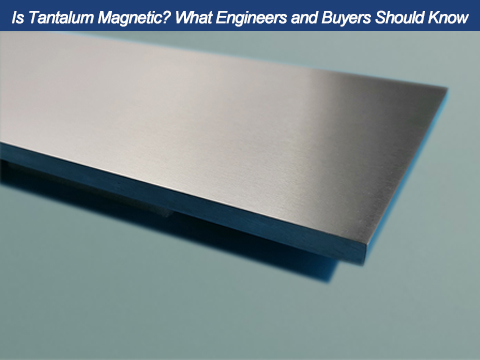
Tantalum is generally considered non-magnetic in practical applications. Technically, tantalum is a weak paramagnetic metal. This means it can respond slightly to an external magnetic field, but it does not retain magnetism after the field is removed. For most industrial and engineering purposes, tantalum is treated as a non-magnetic material.
"Is tantalum magnetic?" This is a common question for many buyers. Magnetic behavior can interfere with sensitive equipment like medical devices and vacuum systems. It also affects the performance of precision electronics. However, in most real-world applications, tantalum's weak magnetic response is not a major concern. Instead, engineers usually focus on a few key factors. They prioritize corrosion resistance, purity, thermal stability, and long service life.
Quick Facts About Tantalum
| Property | Tantalum |
|---|---|
| Magnetic Behavior | Weakly paramagnetic |
| Common Industry Classification | Non-magnetic |
| Atomic Number | 73 |
| Density | 16.6 g/cm³ |
| Melting Point | 2,996°C |
| Main Advantages | Corrosion resistance and high-temperature stability |
Is Tantalum Magnetic or Non-Magnetic?
"Is tantalum magnetic?" Tantalum is generally considered non-magnetic in everyday industrial use. Unlike iron, cobalt, or nickel, tantalum does not strongly attract magnets. It also does not become permanently magnetized after exposure to a magnetic field.
However, from a scientific standpoint, tantalum is slightly paramagnetic. Paramagnetic materials show a weak and temporary response when placed inside an external magnetic field. Once the field is removed, the magnetic effect disappears immediately.
This weak paramagnetic behavior is very different from ferromagnetic metals. Ferromagnetic materials can become strong permanent magnets. Tantalum cannot.
The difference is important for engineers and procurement teams. Many industries rely on tantalum for its stability. It has a weak magnetic response. This ensures it does not interfere with how equipment performs. This is especially valuable in medical, electronics, aerospace, and vacuum applications.
The table below shows how tantalum compares with common magnetic metals.
| Material | Magnetic Type | Retains Magnetism? |
|---|---|---|
| Iron | Ferromagnetic | Yes |
| Nickel | Ferromagnetic | Yes |
| Cobalt | Ferromagnetic | Yes |
| Tantalum | Paramagnetic | No |
| Copper | Non-magnetic | No |
When people ask "is tantalum magnetic or non-magnetic", they are usually asking whether it behaves like steel or iron. In practical terms, the answer is no. Tantalum does not show strong magnetic attraction during normal industrial use.
This is one reason why tantalum metal is widely used in high-performance environments. Its stable behavior makes it suitable for sensitive systems. In these environments, strong magnetic interference could otherwise create significant problems.
What Causes Tantalum's Magnetic Behavior?
To understand why tantalum is weakly magnetic, it helps to understand how metals respond to magnetic fields. Magnetic behavior comes from the arrangement of electrons inside a material.
In ferromagnetic metals such as iron, many electrons align together in the same direction. This creates strong magnetic fields inside the material. As a result, the metal can strongly attract magnets and even remain magnetized afterward.
Tantalum behaves differently. Its electron structure does not allow strong magnetic alignment. Instead, tantalum only reacts slightly when exposed to an external magnetic field. Once the field disappears, the effect also disappears.
There are three main categories of magnetic behavior in metals.
| Magnetic Type | Behavior |
|---|---|
| Ferromagnetic | Strong attraction and permanent magnetism |
| Paramagnetic | Weak temporary attraction |
| Diamagnetic | Slight repulsion from magnetic fields |
Tantalum belongs to the paramagnetic category. This means it has a very weak magnetic response compared with strongly magnetic metals.
For industrial buyers, this distinction is significant. This is because weak paramagnetism usually does not affect real-world performance. In most applications, tantalum is selected for other properties rather than magnetic behavior.
These properties include:
- Excellent corrosion resistance
- Very high melting point
- Good thermal stability
- Strong chemical resistance
- High density
- Long service life
In industries like aerospace and medical manufacturing, magnetism is rarely the main concern. Engineers there focus on more critical factors. These include material purity and overall mechanical performance.
Another important point is that tantalum does not interfere strongly with nearby components. This makes it useful in precision systems and specialized equipment. In these applications, stable material behavior is important.
The question "is tantalum magnetic" has a technical scientific answer. However, for most buyers, the practical answer is simpler. In normal industrial conditions, tantalum behaves like a non-magnetic material.
Tantalum vs Niobium Magnetic Properties
Tantalum and niobium are closely related refractory metals. Both belong to Group 5 of the periodic table, and both are widely used in advanced industrial applications. Because of their similarities, many buyers compare tantalum and niobium when selecting materials.
When discussing "is tantalum magnetic", it is also useful to compare tantalum vs niobium magnetic behavior.
Both metals are weakly paramagnetic under normal conditions. Neither metal behaves like iron or steel. However, niobium is especially known for its superconducting properties at very low temperatures.
Superconductivity allows certain materials to conduct electricity with almost zero resistance under special conditions. Niobium is widely used in superconducting magnets, MRI systems, particle accelerators, and quantum-related technologies.
Tantalum, on the other hand, is more widely known for corrosion resistance and stability in harsh environments.
The comparison below highlights the differences between the two metals.
| Property | Tantalum | Niobium |
|---|---|---|
| Atomic Number | 73 | 41 |
| Density | 16.6 g/cm³ | 8.57 g/cm³ |
| Melting Point | 2,996°C | 2,477°C |
| Corrosion Resistance | Excellent | Very good |
| Superconductivity | Limited practical focus | Highly notable |
| Common Applications | Capacitors, chemical equipment | Superconductors, aerospace |
Buyers may choose between tantalum and niobium. The decision usually depends on the application environment.
Tantalum is often preferred when extreme corrosion resistance is required. This includes chemical processing systems, heat exchangers, and medical components.
Niobium is commonly selected for superconducting applications and lightweight high-performance alloys.
Another factor is density. Tantalum is much denser than niobium. This can affect weight-sensitive applications or designs that require specific mechanical properties.
When evaluating tantalum vs niobium magnetic behavior, both metals are considered weakly magnetic. However, the practical selection process usually depends more on other factors. These include corrosion resistance, thermal performance, conductivity, and specific manufacturing requirements.
Why Tantalum Is Valuable in Industrial Applications
Even though many people ask "is tantalum magnetic", magnetic behavior is only a small part of what makes tantalum valuable. Tantalum is actually one of the most important refractory metals used in modern industry.
Its biggest advantages are corrosion resistance, high melting point, and durability. It also exhibits great stability under harsh conditions.
Tantalum can resist attack from many aggressive chemicals and acids. This is why it is widely used in chemical processing equipment. In some environments, tantalum performs almost like glass in terms of corrosion resistance. It also provides the strength of metal.
It has a high melting point (nearly 3,000°C). This makes tantalum suitable for extremely high-temperature environments. Many furnace systems, vacuum components, and aerospace parts rely on tantalum. The reason is that ordinary metals cannot survive these conditions.
Another major advantage is biocompatibility. Tantalum is well tolerated by the human body. This makes it valuable for medical implants and surgical devices.
The electronics industry also depends heavily on tantalum. Tantalum capacitors are widely used. They provide high reliability and stable electrical performance in compact devices.
Important tantalum metal properties include:
- Excellent corrosion resistance
- High thermal stability
- Good electrical conductivity
- Strong mechanical reliability
- Resistance to chemical attack
- Long operational lifespan
These properties help explain why tantalum is used in industries that require precision and reliability.
For procurement teams, material consistency is also critical. High-purity tantalum with controlled dimensions and stable quality can improve manufacturing performance and reduce production risks.
This is why many industrial buyers request custom tantalum products based on exact application requirements.
Does Tantalum's Weak Magnetism Matter in Real Applications?
In most industrial applications, tantalum's weak magnetic behavior does not create major problems. Engineers usually care far more about other factors. These include corrosion resistance, purity, thermal performance, and dimensional stability.
Still, some buyers ask "is tantalum magnetic". This is because they work with sensitive systems where magnetic interference may matter.
In practical terms, tantalum's weak paramagnetic response is usually too small to affect normal operation.
Is Tantalum Safe for Sensitive Equipment?
Yes, tantalum is commonly used in sensitive equipment. This is because it does not retain magnetism. As a result, it is much less likely to interfere with nearby components. This gives it a major advantage over ferromagnetic materials.
This makes tantalum suitable for electronics, precision instruments, and specialized manufacturing systems.
Can Tantalum Be Used in Vacuum Systems?
Tantalum performs very well in vacuum environments. It offers excellent thermal stability and low vapor pressure at high temperatures. These properties make tantalum useful for vacuum furnaces, heat shields, and high-temperature processing equipment.
Its weak magnetic behavior is rarely a concern in these systems.
Is Tantalum Suitable for Medical Devices?
Yes. Tantalum is widely used in medical implants and surgical applications. This is because it is biocompatible and corrosion resistant.
Medical manufacturers often value tantalum. It combines stability with long-term durability inside the human body.
For many applications, the key factors are:
- Material purity
- Surface finish
- Mechanical reliability
- Corrosion resistance
- Dimensional accuracy
Magnetic behavior is usually a secondary concern.
This is important for buyers. It shows that selecting tantalum should involve evaluating the full material specification. It's not reasonable to focus only on the question "is tantalum magnetic".
Common Industrial Uses of Tantalum

Tantalum is used across many industries because of its unique combination of properties. Its corrosion resistance, thermal stability, and reliability make it valuable in demanding environments.
The electronics industry is one of the largest users of tantalum. Tantalum capacitors are widely used in smartphones, computers, automotive electronics, and telecommunications systems. These capacitors are known for stable performance and compact size.
In chemical processing, tantalum is used for corrosion-resistant equipment such as:
- Heat exchangers
- Reactor linings
- Pipes
- Valves
- Chemical vessels
Many aggressive chemicals can quickly damage ordinary metals. Tantalum can survive these harsh environments for long periods.
The medical industry also depends on tantalum. Medical implants, bone repair devices, and surgical components often use tantalum. This is because it is biocompatible and resistant to body fluids.
Aerospace manufacturers use tantalum in high-temperature systems and critical components where strength and heat resistance are important.
Tantalum is also valuable in vacuum furnace systems and advanced manufacturing equipment.
The table below shows why industries choose tantalum.
| Industry | Why Tantalum Is Used |
|---|---|
| Electronics | Reliable capacitor performance |
| Medical | Biocompatibility |
| Chemical Processing | Corrosion resistance |
| Aerospace | High-temperature stability |
| Manufacturing | Durability in vacuum systems |
Another reason tantalum is popular is its long service life. Although tantalum can be more expensive than common metals, its durability often reduces replacement frequency and maintenance costs.
This makes tantalum attractive for applications where failure is costly or dangerous.
As industries continue to demand higher performance materials, tantalum remains an important solution for advanced engineering environments.
What Tantalum Forms and Grades Should Buyers Request?

When buyers search for "is tantalum magnetic", they are often also evaluating which tantalum product form best fits their application.
Tantalum is available in many forms, including sheet, plate, foil, rod, wire, tube, powder, crucibles, and sputtering targets. Each form supports different manufacturing and engineering needs.
The table below shows common tantalum forms and their typical uses.
| Product Form | Typical Use |
|---|---|
| Foil | Capacitors and electronics |
| Rod | Machining and fabrication |
| Sheet and Plate | Chemical vessels and linings |
| Wire | Electronics and precision components |
| Powder | Metallurgy and advanced processing |
| Sputtering Targets | Thin-film deposition |
Tantalum sheet and plate are commonly used in chemical processing systems because they provide strong corrosion resistance over large surface areas.
Tantalum rod and bar products are often selected for machining operations and custom fabricated components.
Tantalum wire is widely used in electronics and precision manufacturing environments.
Tantalum powder is important for powder metallurgy and capacitor production.
Sputtering targets are used in semiconductor and coating applications where thin films are required.
Buyers should also pay close attention to specification details, including:
- Purity level
- Dimensional tolerance
- Surface condition
- Mechanical properties
- Manufacturing standards
- Custom machining requirements
For many industrial customers, custom manufacturing is essential. Different applications may require special dimensions, tighter tolerances, or unique processing conditions.
This is especially true in aerospace, electronics, medical, and semiconductor industries where precision is critical.
Working with an experienced tantalum supplier can help ensure consistent material quality and reliable long-term performance.
Conclusion
So, is tantalum magnetic? In most practical applications, tantalum is considered non-magnetic. Technically, it is a weak paramagnetic metal. It only shows a very small response to external magnetic fields. It also does not retain magnetism after the field is removed.
For engineers and industrial buyers, tantalum's weak magnetic behavior is usually not the main concern. More important factors include corrosion resistance, thermal stability, purity, and long-term reliability.
Tantalum performs extremely well in harsh environments. It can handle high temperatures and aggressive chemicals. It also offers excellent durability and stable performance. Because of this, tantalum is widely used in electronics, aerospace, medical devices, vacuum furnaces, and chemical processing systems.
When choosing tantalum materials, buyers should evaluate the full specification carefully. Important factors include purity level, dimensions, tolerances, surface condition, and manufacturing quality. Selecting the right tantalum form can improve product performance and service life.
SIZEN LIMITED supplies high-purity tantalum products for demanding industrial applications. Available forms include tantalum sheet, plate, foil, rod, wire, tube, powder, crucibles, and sputtering targets. Custom dimensions and OEM manufacturing services are also available to meet different project requirements.
Our team understands the needs of industrial buyers, manufacturers, and engineering companies. We focus on stable quality, precision manufacturing, and reliable global supply. Whether you need standard tantalum materials or custom solutions, SIZEN LIMITED can support your project with professional service and technical experience.
If you are looking for high-quality tantalum products, welcome to contact SIZEN LIMITED for quotations, technical support, and customized solutions. Our team is ready to help you find the right tantalum material for your application.
Recent News
- Niobium vs Titanium: A Practical Material Selection Guide
- ASTM B708 Tantalum: Grades, Requirements & Buying Guide
- Niobium Ring Explained: Benefits, Applications and Sourcing Guide
- Tantalum Atomic Mass: What It Is and Why It Matters for Industrial Applications
- Niobium Density: How It Affects Material Performance and Design
- Tantalum Watch: Why This Rare Metal Is Becoming a Luxury Watchmaking Favorite
- Niobium Melting Point Explained: Properties, Comparisons, and Industrial Uses
- Tantalum Melting Point: Why 3,017°C Makes It One of the Most Valuable Refractory Metals
- Tantalum Density Explained: Why This Heavy Metal Matters
- Tantalum Hafnium Carbide (Ta₄HfC₅): The Ultra-High-Temperature Material Behind Advanced Engineering