
Niobium vs Titanium: A Practical Material Selection Guide
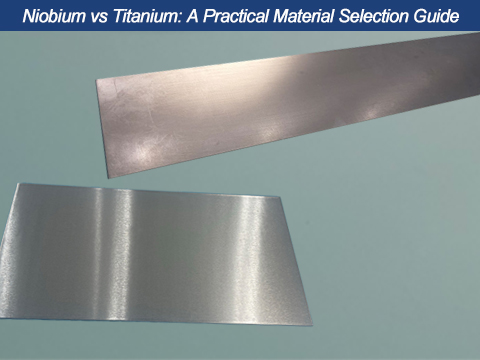
Niobium and titanium are corrosion-resistant metals. They're usually used in aerospace, medical, chemical, and advanced engineering applications. The main difference in niobium vs titanium is weight and temperature performance. Titanium is much lighter. Niobium has a much higher melting point and unique superconducting properties. The best choice depends on the application's operating conditions and performance needs.
| Property | Niobium | Titanium | Design implication |
|---|---|---|---|
| Density | 8.57 g/cm³ | 4.51 g/cm³ | Titanium is about 47% lighter |
| Melting point | 2,477°C | 1,668°C | Niobium offers much higher temperature capability |
| Young's modulus | 104.9 GPa | Grade-dependent | Compare the exact grade and condition |
| Corrosion resistance | Excellent in many environments | Excellent in many environments | Check the actual service environment |
| Superconductivity | Transition temperature about 9.3 K | Not typical for elemental titanium | Niobium has a unique advantage |
What Is the Main Difference Between Niobium and Titanium?
Titanium and niobium differ significantly in their physical traits. Titanium is the lighter metal of the two. On the other hand, niobium handles much higher temperatures. It also features valuable superconducting properties.
- Titanium is widely used across many industries. It is selected when low weight and corrosion resistance are essential. It also offers exceptional strength-to-weight performance.
- Niobium is a refractory metal. It's highly valued for its exceptional melting point and strong corrosion resistance. It also plays a key alloying role and exhibits unique superconducting behavior.
- Niobium-titanium alloys offer another great option for engineers. They provide unique properties for demanding projects. Pure niobium or titanium alone cannot deliver these specific benefits.
Therefore, there is no universal winner in the niobium vs. titanium comparison. The right choice depends on your specific application. Engineers should carefully evaluate temperature, weight, and mechanical loads. They must also consider corrosion factors, electrical requirements, and the exact material grade.
Niobium vs Titanium: Density and Weight
Weight is one of the clearest differences between niobium and titanium.
Titanium has a density of about 4.51 g/cm³, while niobium has a density of approximately 8.57 g/cm³. This means that a same-volume niobium component weighs about 1.9 times as much as a titanium component.
Relative weight = 8.57 ÷ 4.51 ≈ 1.90
For example, consider a component with a volume of 1,000 cm³:
- Titanium mass: about 4.51 kg
- Niobium mass: about 8.57 kg
- Difference: about 4.06 kg
This key advantage makes titanium popular across several industries. It is widely used in aerospace structures and transportation equipment. Rotating components and other weight-sensitive designs also benefit from it.
However, density should not be the only selection factor. If the component faces extreme temperatures or requires superconducting performance, niobium may provide advantages that titanium cannot.
Niobium vs Titanium Melting Point and Temperature Performance
The melting point is another major difference in niobium vs titanium.
- Niobium: 2,477°C
- Titanium: 1,668°C
- Difference: about 809°C
Niobium has a much higher melting point than titanium. Because of this, it is classified as a refractory metal. This property makes it relevant to specialized high-temperature materials. It is also key to thermal processing and high-temperature alloy systems.
However, melting point is not the same as maximum operating temperature. Real components can be limited by oxidation, creep, stress, thermal cycling, atmosphere, coatings, and joint design.
For this reason, engineers should evaluate the complete service environment. They should not select a material based only on its melting point. A full environmental review ensures better long-term performance.
Strength, Stiffness, and Mechanical Properties
Which metal is stronger, niobium or titanium? There is no simple answer.
Mechanical performance depends on:
- Material purity
- Alloy composition
- Heat treatment
- Manufacturing process
- Product form
- Grain structure
- Operating temperature
Titanium alloys are well known for high strength-to-weight performance. However, this reputation mainly applies to engineered alloys. It does not apply equally to every grade of commercially pure titanium.
Pure niobium has a Young's modulus of about 104.9 GPa. Titanium can have a similar stiffness range depending on its grade. However, titanium alloys vary widely. They offer distinct combinations of strength, stiffness, ductility, and fatigue resistance.
Before making a niobium vs titanium decision, buyers should ask:
- Is the component load-bearing?
- Is fatigue performance critical?
- Is low weight important?
- What temperature will the component reach?
- Is the material required as sheet, plate, bar, rod, wire, tube, foil, or powder?
- What purity and mechanical specifications are required?
Niobium vs Titanium Corrosion Resistance
Both niobium and titanium offer strong corrosion resistance in many environments. However, neither should be considered universally corrosion-proof.
Titanium forms a stable protective oxide film that contributes to its corrosion resistance. Niobium also performs well in many corrosive environments. It's usually used in specialty chemical and medical applications.
The better choice depends on the actual service conditions, including:
- Chemical medium
- Temperature
- Pressure
- Chloride concentration
- Impurities
- Galvanic contact
- Surface condition
| Service environment | Titanium | Niobium | Procurement action |
|---|---|---|---|
| Seawater and chlorides | Often a strong option | May suit specialized applications | Check exact chemistry |
| Chemical processing | Excellent in many services | Useful for specialty applications | Request application-specific data |
| Medical applications | Widely established | Useful in specialized materials and alloys | Confirm medical requirements |
| High-temperature service | Temperature may become limiting | Higher temperature potential | Evaluate atmosphere and duty cycle |
Corrosion testing is critical for chemical-processing equipment. The test conditions must match your actual operating environment. Be sure to align the fluid, concentration, and temperature parameters accurately.
Niobium vs Titanium for Medical Implants

Titanium is widely used for medical implants because of its low density, corrosion resistance, and established biocompatibility.
Niobium is also important in medical materials, especially as an alloying element in titanium alloys. In particular, titanium-niobium alloys are studied for β-phase titanium systems with potentially lower elastic modulus.
This matters because a large difference between implant stiffness and bone stiffness can contribute to stress shielding. Researchers have therefore investigated Ti–Nb alloys as potential materials for orthopedic applications.
However, material performance varies with composition and manufacturing method. A result from one Ti–Nb composition should not be applied to every titanium-niobium alloy.
Medical applications require careful evaluation. Buyer must consider composition, cleanliness, and material traceability. Biocompatibility, manufacturing controls, and regulatory requirements are also critical. Do not assume raw niobium is medical-grade. It is not automatically approved for implantation.
Niobium vs Titanium in Aerospace and High-Temperature Applications

Aerospace applications show why the niobium vs titanium decision must be based on the actual design requirement.
Titanium is often preferred for lightweight structural components because its density is much lower than niobium. It can provide a useful combination of strength, corrosion resistance, and low weight.
Niobium becomes more attractive when high-temperature performance or specialized alloy properties are more important than mass.
| Design requirement | Starting point | Main reason |
|---|---|---|
| Lightweight structural parts | Titanium or titanium alloys | Much lower density |
| High-temperature refractory applications | Niobium or niobium alloys | Higher melting point |
| Specialized propulsion systems | Evaluate niobium-based materials | Temperature capability may be critical |
| Cryogenic superconducting systems | Nb–Ti or another niobium-based material | Superconducting performance |
Actual aerospace material selection must also consider oxidation, creep, thermal cycling, coatings, stress, fabrication, and qualification requirements.
Why Niobium Is Different: Superconductivity
Superconductivity is one of the most important differences in niobium vs titanium.
Elemental niobium has a superconducting transition temperature of about 9.3 K. This gives niobium a unique role among elemental metals in cryogenic technology.
Niobium-based superconducting materials are used in systems that require strong magnetic fields at very low temperatures.
| Material system | Why it matters | Typical applications |
|---|---|---|
| Pure niobium | Superconducting at cryogenic temperatures | RF cavities and research |
| Nb–Ti | Established superconducting alloy | MRI magnets and accelerators |
| Titanium | Not normally used as an elemental superconducting conductor | Lightweight structural applications |
This also shows why niobium vs titanium is sometimes the wrong final comparison. In superconducting applications, the practical choice may be niobium-titanium alloy rather than either pure metal.
Niobium–Titanium Alloy: When the Combination Makes More Sense
A niobium titanium alloy can provide properties that neither pure metal offers by itself.
Nb–Ti is an established superconducting alloy used in:
- MRI magnets
- Particle accelerators
- Cryogenic magnet systems
- Other superconducting equipment
Titanium-niobium alloys are also studied for medical and engineering applications where engineers want to adjust properties such as elastic modulus and corrosion resistance.
Therefore, the best answer to niobium vs titanium may sometimes be "both". Alloy design allows engineers to combine elements to achieve a more suitable performance profile.
Cost and Sourcing Considerations
Material price alone does not determine the best choice.
The total procurement cost can depend on:
- Purity
- Alloy grade
- Product form
- Dimensions and tolerances
- Surface finish
- Order quantity
- Custom processing
- Testing and inspection
- Traceability and documentation
- Lead time and delivery requirements
Titanium may be attractive when low weight and broad industrial availability are important. Niobium can justify its use when its high-temperature, corrosion-resistant, alloying, or superconducting properties solve a specific engineering requirement.
For B2B buyers, the right question is therefore not simply "Which metal costs less?" It is "Which material provides the required performance at the lowest overall project cost?"
Niobium vs Titanium: Which Should You Choose?
There is no universal winner in the niobium vs titanium comparison. The right starting material depends on the application's priorities.
| If your priority is... | Consider... | Why |
|---|---|---|
| Low weight | Titanium | Density is about 4.51 g/cm³ |
| High melting point | Niobium | Melting point is about 2,477°C |
| Lightweight structures | Titanium or titanium alloys | Strong strength-to-weight advantage |
| Superconducting magnets | Nb–Ti or another niobium-based alloy | Established superconducting performance |
| Lower-modulus β-titanium alloy development | Titanium-niobium alloys | Niobium can stabilize the beta phase |
| Custom refractory-metal products | Niobium | Suitable for specialized forms and applications |
In short, titanium is usually the better starting point when low weight is the main priority. Niobium becomes more attractive for high-temperature, superconducting, and specialized applications. The final choice should always consider the exact grade, operating environment, geometry, and qualification requirements.
Custom Niobium Products from SIZEN LIMITED
For projects that require niobium rather than titanium, SIZEN LIMITED supplies high-purity niobium products for research, prototypes, and production applications.
Available product forms include:
- Niobium sheet and plate
- Niobium foil
- Niobium bar and rod
- Niobium wire
- Niobium tube
- Niobium crucibles
- Niobium sputtering targets
SIZEN LIMITED focuses on specification-based B2B supply and can discuss requirements such as purity, dimensions, product form, quantity, and custom processing.
Frequently Asked Questions About Niobium vs Titanium
Is niobium stronger than titanium?
Not as a general rule. Strength depends on purity, alloy composition, heat treatment, processing, and product form. Titanium alloys are often selected for lightweight, high-strength components, while niobium is used for specialized high-temperature, alloying, and superconducting applications.
Is niobium heavier than titanium?
Yes. Niobium has a density of about 8.57 g/cm³, compared with approximately 4.51 g/cm³ for titanium. A same-volume niobium component weighs about 1.9 times as much.
Does niobium have a higher melting point than titanium?
Yes. Niobium melts at about 2,477°C, while titanium melts at approximately 1,668°C.
Why is niobium added to titanium alloys?
Niobium can stabilize the beta phase in titanium alloys. It is studied for developing alloys with useful combinations of elastic modulus, corrosion resistance, strength, and biocompatibility.
Is niobium–titanium used in MRI magnets?
Yes. Nb–Ti is an important superconducting alloy used in cryogenic magnets, including MRI systems and high-energy physics equipment.
Conclusion: Niobium vs Titanium—Which Material Is Right for You?
The niobium vs titanium comparison does not have a single winner. Titanium is the better choice when low weight, strength-to-weight performance, and established structural applications are the main priorities. Niobium is more suitable when high-temperature performance, corrosion resistance, alloying capability, or superconductivity is critical. In some applications, a niobium-titanium alloy can provide the best balance of properties.
For engineers and procurement teams, the right material should be selected based on the actual operating temperature, mechanical load, corrosion environment, weight limits, product form, purity, and required specifications.
If your project requires custom niobium sheet, plate, foil, wire, tube, rod, crucibles, or sputtering targets, SIZEN LIMITED can support specification-based requirements for research, prototyping, and production. Contact SIZEN with your material specifications, dimensions, quantity, and application requirements to discuss a suitable niobium solution.
Recent News
- Niobium vs Titanium: A Practical Material Selection Guide
- ASTM B708 Tantalum: Grades, Requirements & Buying Guide
- Niobium Ring Explained: Benefits, Applications and Sourcing Guide
- Tantalum Atomic Mass: What It Is and Why It Matters for Industrial Applications
- Niobium Density: How It Affects Material Performance and Design
- Tantalum Watch: Why This Rare Metal Is Becoming a Luxury Watchmaking Favorite
- Niobium Melting Point Explained: Properties, Comparisons, and Industrial Uses
- Tantalum Melting Point: Why 3,017°C Makes It One of the Most Valuable Refractory Metals
- Tantalum Density Explained: Why This Heavy Metal Matters
- Tantalum Hafnium Carbide (Ta₄HfC₅): The Ultra-High-Temperature Material Behind Advanced Engineering